Framework
One prompt, two kinds of model, one shared skeleton
prefer V2M for prompt alignment
prefer V2M for naturalness
action completion, V2M vs Kimodo
participants in the human study
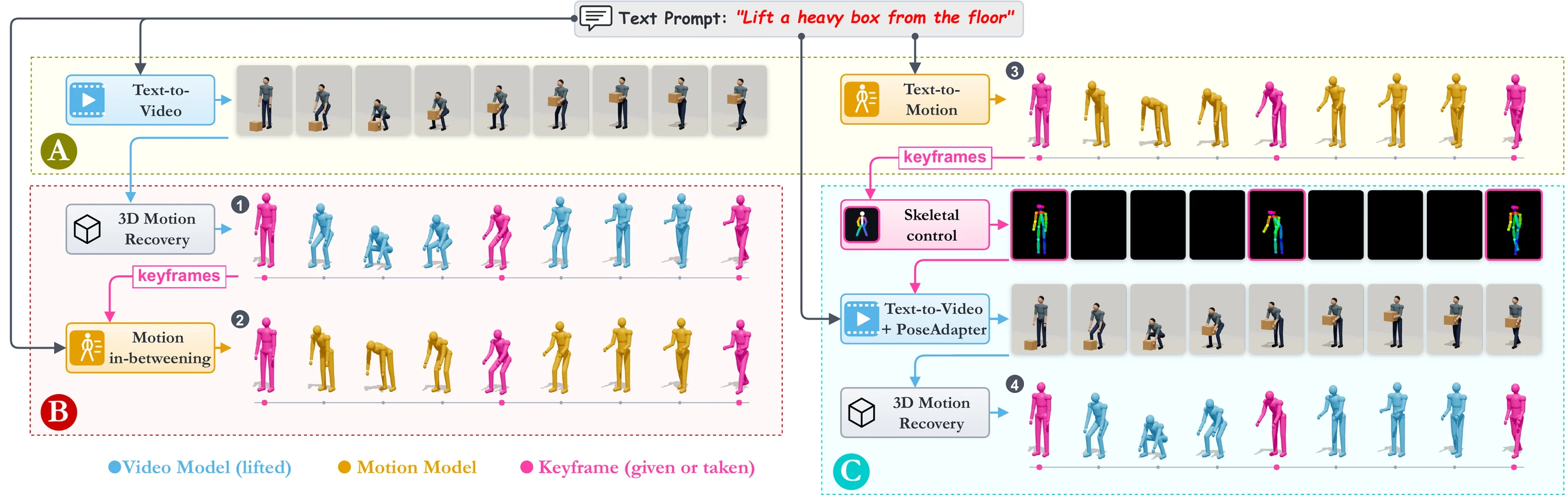
Video foundation models have emerged as powerful generators of dynamic visual content, exhibiting remarkable capabilities in synthesizing complex actions and interactions. We argue that these models have also become excellent motion generators, with motion priors that are richer and more general than those learned by dedicated motion models. Their advantage extends beyond visual realism and is manifested in two important aspects: motion naturalness, including coherent body coordination, physical plausibility, and realistic interactions with objects and the environment; and motion scope, encompassing a much broader range of activities and semantic coherence, particularly uncommon, complex, and compound actions. To investigate this position, we introduce a common evaluation framework that compares video and dedicated motion models through three complementary settings: text-only motion generation, reconstruction of video-generated motion from sparse keyframes, and video-based enrichment of motion-model outputs. By converting all outputs into a shared 3D skeletal representation, we evaluate motion naturalness, semantic alignment, action coverage, physical motion characteristics, and fidelity to motion constraints. Our results suggest that video foundation models can generate more natural and semantically meaningful movements, particularly for complex and compound actions. Moreover, we investigate motion-conditioned generation through loose skeletal control, finding that dedicated motion models do not consistently improve video-generated motion, while video models can enrich skeletal animations using sparse motion guidance. Our findings suggest a shift in the role of specialized motion models, from generating complete animations to guiding and controlling the richer motion capabilities already embedded in video foundation models.
| Exp. | Method | Contact % |
Positional jerk m/s³ ↓ | Ang. RMS °/s² ↓ | Foot sliding cm/s ↓ |
||
|---|---|---|---|---|---|---|---|
| Hands | Feet | Pelvis | |||||
Bold: lowest per experiment. Low kinematic error can also come from barely moving.
From generating motion from scratch, to directing the motion knowledge already inside video models.
@article{izadpanah2026video,
  title   = {Video Models are Excellent Motion Models},
  author  = {Izadpanah, Kian and Mahdavi Amiri, Ali and Cohen-Or, Daniel
             and Chrysanthou, Yiorgos and Aristidou, Andreas},
  year    = {2026}
}